Blog
3-5 Live Mocks to Fix Your McKinsey Case Interview Practice
27 August 2026
The fastest route to readiness combines three things: official McKinsey materials (the Problem Solving Test and published sample cases), daily timed drills across the four core skills, and three to five live mocks in your final fortnight. Start today with three actions: download the PST practice PDF, begin a 20 to 30 minute daily maths drill, and book your first live mock.
TL;DR:
- Success depends on mastering the Problem Solving Test, case interview structure, and Personal Experience Interview through targeted, timed practice in each area.
- Focus daily drills on four core skills: structuring, mental math, exhibit interpretation, and business judgment, with weekly debriefs to track progress.
- Use official McKinsey sample cases in a disciplined attempt-then-review routine, rotating through different scenarios for comprehensive skill development.
- Incorporate live mocks and detailed debriefs, logging mistakes and fixes, to accelerate progress and prevent repeating errors over multiple practice sessions.
- Prepare multiple PEI stories covering key behavioral themes, practicing delivery and follow-up questions to build confidence and authenticity.
Table of Contents
- What to expect: PST, interviewer-led cases and the PEI
- The four core skills to drill, with daily routines
- How to use McKinsey’s official sample cases properly
- Building a 4 to 8 week practice schedule that actually holds
- Preparing PEI stories that actually hold up under follow-up
- Common mistakes and a final-week checklist
- What structured practice actually looks like from the inside
- Turn this plan into practice with Intervyo
- Essential downloads and pages worth bookmarking
- Sources
What to expect: PST, interviewer-led cases and the PEI
McKinsey’s interview process rests on three distinct assessments, and each rewards a different kind of preparation. Confusing them, or preparing for one as if it were another, is the single biggest reason candidates waste weeks of practice.
The Problem Solving Test (PST) is a written screen: 26 questions, 60 minutes, built around three business scenarios with accompanying exhibits, tables and text passages that test quantitative and interpretive reasoning under time pressure. It behaves less like a case interview and more like a timed comprehension exam with numbers attached. Because it’s a fixed, high-variance gate that some offices still use to screen candidates before live interviews, treating it as an afterthought is a mistake many candidates only realise once they’re rejected before ever meeting an interviewer.
The case interview itself is interviewer-led, not candidate-led. That single distinction changes how you should structure practice. In a candidate-led case (the BCG or Bain style many guides default to), you build a full framework, then walk through every branch at your own pace. McKinsey expects something tighter: present a concise structure, explicitly state which branch you intend to open with, and then follow the interviewer’s redirection when it comes. This signals leadership and clarity even when the interviewer steers you elsewhere.
The Personal Experience Interview (PEI) rounds out the picture. McKinsey’s own guidance frames interviewing as a two-way conversation and expects candidates to ask clarifying questions, respond candidly, and maintain integrity throughout the assessment process. The PEI probes specific dimensions of past behaviour, not abstract personality traits, so vague “I’m a team player” answers fall flat.
What this means for your prep schedule:
- Prioritise the PST early if your target office uses it. Treat it as a discrete skill, not a warm-up.
- Practise cases out loud, structuring first and stating your opening branch before diving into analysis.
- Prepare PEI stories with the same rigour you’d give a case, not as an improvised afterthought.
The four core skills to drill, with daily routines
Every McKinsey case interview practice plan, however it’s dressed up, boils down to four skills. Candidates rarely fail because they didn’t know a framework. They fail because one of these four broke down under pressure.
Structuring is the ability to break an ambiguous business question into a clear, prioritised set of hypotheses within roughly 60 to 90 seconds of hearing the prompt. The common error is building a framework so broad it says nothing specific about the client’s actual problem.
Case maths covers mental arithmetic, quick estimation and sanity-checking under a ticking clock. Candidates who are otherwise strong often stall here simply because they haven’t drilled the reflexes.
Exhibit interpretation means reading a chart or table, extracting the one or two numbers that matter, and stating what they imply for the client, in that order. Many candidates reverse this, describing the data before deciding what it means.
Business judgement and communication is the hardest to fake. It’s the ability to synthesise findings into a recommendation a client would actually act on, delivered with the top line first.
Here’s a daily and weekly routine that trains all four without needing a study partner every day:
- 90-second structuring drill. Read a case prompt (from an official sample or a worked example), set a timer, and speak your structure aloud before you look at any data.
- 20 to 30 minutes of maths practice daily. Percentages, breakevens, weighted averages and quick estimation, done without a calculator until the final check.
- Exhibit routine: read, compute, synthesise. Look at one exhibit, do the calculation it demands, then state the “so what” in a single sentence before moving on.
- Judgement exercises. Take any structured finding and force yourself to write a two-sentence recommendation, as if speaking to a client partner.
- Interviewer-led responsiveness practice. Ask a study partner (or yourself, on tape) to redirect you mid-case, and practise pivoting without losing your original thread.
Track three micro-metrics weekly: maths accuracy on timed drills, whether you complete structuring within 90 seconds, and how many debrief notes you generate per case. That last one matters more than most candidates think.
Pro Tip: Record yourself doing a full case out loud once a week. Listening back is uncomfortable, but it’s the fastest way to hear the filler words and hedging that a live interviewer will notice immediately.
How to use McKinsey’s official sample cases properly
McKinsey’s careers site publishes a set of sample cases precisely so candidates can rehearse against realistic material before the real thing, and they’re the single highest-value free resource available for McKinsey case interview practice. Working them badly, though, wastes most of their value.
The routine that actually builds skill: attempt the case cold and timed, exactly as you would in the room. Then debrief immediately, before you look at any model answer, noting where your structure broke down or where you missed an exhibit implication. Only then compare against the guidance provided. Finally, rework the one weakness you identified, rather than moving straight to a new case. Reading a solution passively, without attempting the case first, is measurably less effective than this attempt-then-check discipline.
McKinsey’s named sample cases each train a distinct muscle:
- Beautify is a market entry case, useful for practising how you scope a new-market decision and structure the trade-offs.
- Diconsa works profitability and operational logistics, a good test of exhibit-heavy quantitative reasoning.
- Electrolight covers a product launch scenario, which rewards judgement about timing and go-to-market sequencing.
- Talbot Trucks and similar investment-style cases push you towards evaluating returns and capital allocation logic.
Rotate through all of them rather than repeating your favourite. Once you’ve exhausted the official set, curated collections such as I Got An Offer’s case library offer breadth, though most are written candidate-led. Adapt them: present your structure and nominate a starting branch before proceeding, just as you would in a real McKinsey room. Worked examples that mirror McKinsey’s pacing, like this renewable energy case, work well for the same attempt-first, check-second approach.
Building a 4 to 8 week practice schedule that actually holds
Most candidates either over-plan and never execute, or drill randomly without checking whether they’re improving. A structured schedule fixes both problems.
For a standard two-month runway:
- Weeks 1 to 2: foundations. Learn the four core skills, complete the PST practice PDF at least twice, and do daily maths drills. No live mocks yet.
- Weeks 3 to 5: repetitions. Work through official and external cases at a rate of roughly one every one to two days, debriefing each thoroughly. This is where most of your volume should land.
- Weeks 6 to 7: live mocks and sharpening. Book three to five live mocks, spaced a few days apart so you can act on feedback between sessions.
- Final week: consolidation. Light review only, no new material. Sleep and logistics take priority.
If you’re starting later, a compressed two to three week version works: cut foundations to two or three days, front-load cases into the first ten days, and still protect time for at least two or three live mocks before the real interview.
On volume, a well-regarded preparation guide recommends a moderate number of high-quality cases for beginners, dropping to 20 to 30 for candidates with prior case experience, alongside three to five live mocks concentrated in the final two weeks. More cases beyond that range tends to produce diminishing returns once your structuring and maths have stabilised; at that point, live mock feedback teaches you more per hour than another solo repetition.
After every mock, log three things in a short debrief template: what broke down first, what the interviewer had to correct, and one specific fix to test in the next session. Without that written record, most candidates repeat the same error across five mocks without noticing the pattern.

Preparing PEI stories that actually hold up under follow-up
McKinsey’s Personal Experience Interview probes specific behavioural dimensions rather than generic soft skills, and candidates who prepare only one polished story per theme tend to run dry the moment an interviewer asks a follow-up question.
Prepare two to three stories for each dimension McKinsey commonly probes, covering situations like leading through a setback, managing a difficult team dynamic, and driving a personal achievement against resistance. Each story should follow a tight structure: the context in one or two sentences, the specific action you took, a measurable impact (a number, a timeframe, a concrete outcome), and a short honest lesson.
- Write each story down once, then practise telling it from memory, not from the page.
- Vary your delivery across practice sessions rather than reciting the same script word for word, since over-memorised answers sound stilted under real follow-up questions.
- Time yourself: two minutes is usually the right length for an initial answer, leaving room for the interviewer to probe deeper.
- Roleplay variations with a partner who deliberately interrupts or asks “why” twice, since that’s exactly what happens in the room.
Common mistakes and a final-week checklist
Most McKinsey case interview practice failures trace back to a handful of avoidable habits, not a lack of raw ability.
The biggest one: passive review instead of timed, voiced practice. Reading model solutions feels productive but builds almost no real skill compared with attempting a case cold, out loud, against the clock. The second most common: neglecting maths drills because a candidate feels “generally good with numbers”, only to freeze during a live exhibit calculation. Third: presenting a bloated, unfocused structure instead of a tight, prioritised one with a clear starting branch.
Final-week checklist:
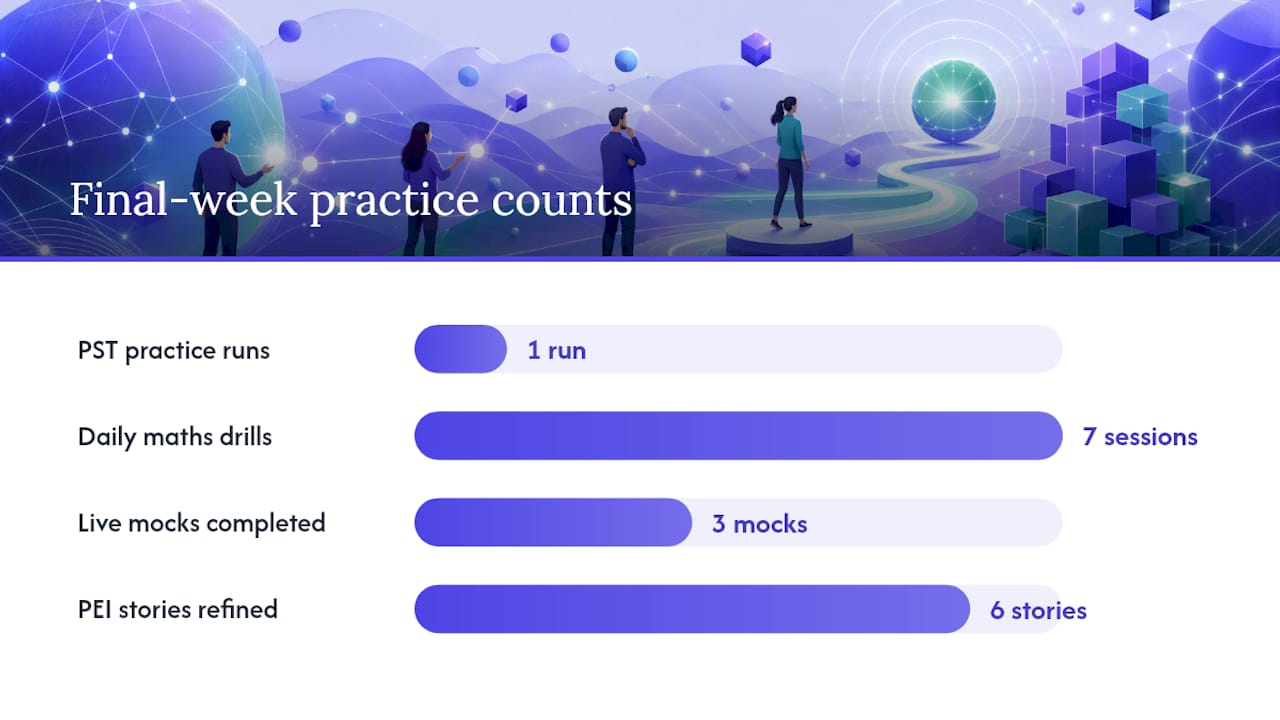
- PST practice PDF completed at least once in the past week.
- Daily maths drill maintained, even if shortened to 15 minutes.
- Three live mocks completed, with debrief notes for each.
- Six PEI stories refined and timed at roughly two minutes each.
- Interview logistics confirmed and a proper night’s sleep protected before the final day.
Pro Tip: If you make a maths error mid-case, say so immediately and correct it rather than hoping the interviewer didn’t notice. “Let me recheck that number, I think I made an error” reads as rigour, not weakness.
What structured practice actually looks like from the inside
Candidates who switch from scattered, unstructured revision to a measurable routine tend to show a distinct progress curve: a slow first week or two while the four core skills bed in, then a noticeably steeper improvement once live mock feedback starts correcting habits that solo practice can’t catch. The plateau most candidates hit isn’t a knowledge gap. It’s the absence of anyone telling them, specifically, what broke down in their last case.
Combining PST drills, interviewer-led case repetitions and PEI preparation in the same routine works precisely because the three assessments test overlapping muscles: quantitative reasoning, structured thinking under time pressure, and clear communication of a conclusion. Preparing for them separately, in isolation, wastes the overlap.
For candidates who prefer a guided system over piecing together PDFs and forum threads, a structured firm-specific approach tends to compress that plateau considerably faster than solo effort alone.
- Intervyo
Turn this plan into practice with Intervyo
Intervyo gives you the McKinsey-specific reps this plan calls for, without the guesswork of stitching together forum threads and outdated PDFs. Where generic case guides leave you rehearsing against strangers’ feedback, Intervyo’s live AI interviews with Vyo score your structuring, maths and communication against real McKinsey-style prompts, then hand you a debrief you can actually act on.
The platform’s McKinsey firm pack bundles interviewer-led case drills, PST-style timed practice and PEI story coaching into one system built around this exact preparation sequence, rather than the candidate-led format most generic guides assume. If you’re also facing HireVue or psychometric stages before your case interview, free HireVue practice and assessment test prep cover those gates with the same measurable feedback loop.
Start with the firm pack, book your first live mock this week, and let the debrief data tell you exactly which of the four core skills needs the next hour of your attention.
Essential downloads and pages worth bookmarking
Keep these close during your preparation:
- McKinsey’s official interviewing page, covering the PST, PEI and case format directly from the source.
- The official PST Practice Test C PDF, the closest thing to the real screening format.
- Official sample cases including Beautify, Diconsa, Electrolight and Talbot Trucks.
- A worked case example with a full solution for practising the attempt-then-check routine.
- 47 curated case examples once you’ve exhausted the official set and need additional volume.
Sources
- Interviewing at McKinsey | Tips and resources | McKinsey & Company
- McKinsey case example: try it yourself (with solution) - CaseInterviewHub